
آزمایشگاه مکانیک خاک - civeng دانشکده مهندسي عمران
Soil Mechanics Laboratory
Introduction:
The Soil Mechanics Laboratory is the oldest section of the Civil Engineering Faculty laboratories, with a history dating back to the establishment of the Civil Engineering Department in 1934 (1313 in the Iranian calendar). The laboratory was transformed into a comprehensive and standardized facility in the 1970s (1350s in the Iranian calendar) and has undergone several major expansions in the past two decades, particularly in its research sections. Today, it is considered one of the most advanced and well-equipped soil mechanics laboratories in the country, the Middle East, and even globally.
Currently, the laboratory’s educational and research activities are carried out across three main sections: Soil Mechanics, Soil Dynamics, and Physical Modeling. The Soil Mechanics section continuously provides high-quality educational services to all Civil Engineering students. At the same time, it offers significant research and consultancy services, including geotechnical investigations, in-situ testing, and laboratory experiments, to various civil and industrial sectors across the country. All standard and advanced soil mechanics tests are performed in this section.
The Soil Dynamics section, supported by the expertise of faculty members and laboratory specialists, along with its highly advanced and unique equipment, is a leading part of the laboratory for conducting dynamic tests on soil samples. Numerous studies on soil dynamic behavior have been conducted in this section through theses and research projects, with many ongoing.
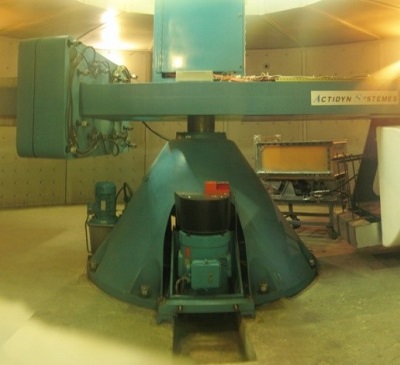
The Physical Modeling section is one of the most important parts of the laboratory, enabling geotechnical physical modeling experiments under 1g gravity (shaking table) and ng conditions (geotechnical centrifuge). Physical models of geotechnical structures are designed and constructed according to scale similarity laws, allowing for both static and dynamic testing. Many research projects and student theses have been completed in this section, with numerous ongoing projects as well.
Laboratory Facilities and Equipment:
Soil Mechanics Section:
Equipment for standard and advanced soil mechanics tests, including:
-
Particle size analysis (sieve and hydrometer)
-
Atterberg limits tests
-
Specific gravity determination of soil solids
-
Consolidation tests
-
Direct shear tests
-
Static triaxial tests
-
Uniaxial compression tests
-
Soil permeability tests
-
Compaction tests
-
California Bearing Ratio (CBR) tests
-
Sand equivalent tests (S.E.)
-
Soil dispersivity (Pin hole) tests
-
Non-erodible filter (NEF) tests
Soil Dynamics Section:
-
Large-scale dynamic triaxial apparatus
-
Two-directional dynamic simple shear device
-
Large-scale hollow torsional cylinder device
-
Resonant column device
-
Cyclic triaxial apparatus
-
Piezoelectric bender elements
-
Additional triaxial cells for specimen consolidation
-
Geophysical field testing equipment, including seismic refraction and downhole methods
Physical Modeling Section:
-
1g shaking table
-
Geotechnical centrifuge
-
Centrifuge shaking table
-
Calibration chamber with laboratory CPT device
-
Miniature CPT device in the centrifuge
-
Various experimental model boxes
-
Fault simulation boxes in the centrifuge
-
Static and dynamic data loggers
-
Various sensors for physical model measurements
Laboratory Services:
Thanks to the expertise of faculty members and laboratory specialists, as well as the advanced equipment available, the Soil Mechanics Laboratory is capable of providing research and engineering services to the academic community, as well as civil and industrial sectors in the country and the region, in various geotechnical engineering areas, including:
-
Providing engineering and research services in soil dynamic behavior and conducting advanced dynamic element tests
-
Physical modeling of various geotechnical engineering problems using the 1g shaking table and geotechnical centrifuge (ng) as part of research and engineering services
-
Performing all standard and advanced soil mechanics tests, as well as geotechnical research and industrial services, including geotechnical investigations, in-situ testing, and laboratory experiments
Research Areas:
-
Studying the static and dynamic behavior of soils using advanced static and dynamic element tests
-
Investigating the static and dynamic (seismic) behavior of geotechnical structures through physical modeling with the 1g shaking table and geotechnical centrifuge (ng)
For the complete and detailed laboratory page, please refer to the link below: